Technical data sheets by SalesChef
What is a technical data sheet?
The maker’s document of a product’s specs: materials, performance, dimensions, ratings and approvals.
Technical data sheets by SalesChef
A technical data sheet (TDS) is the maker’s document of a product’s specs: what it is made of, how it performs, its sizes, ratings and approvals. A safety data sheet (SDS) is a different document, about hazards and safe handling. SalesChef reads the maker’s data sheets, checks every spec against the newest one, and turns the specs into product pages, counter cards and rep talk tracks, ready for your yes.
sections in the set format OSHA specifies for every safety data sheet.
OSHA Hazard Communication (opens in a new tab)The maker’s spec sheet for one product or range, also called a datasheet or spec sheet. It sits beside three other documents the trade asks for.
Specs and performance: materials, dimensions, ratings, approvals and installation.
Hazards, handling, storage and first aid, in the set format OSHA specifies.
A shorter sheet for buyers: the key specs, a picture and the order codes.
How to fit it, with the connections, pressures and clearances the trade checks.
The product name, the model number, every variant’s code and the barcode.
Materials, finishes and coatings, named the way the trade names them.
Ratings for flow, pressure, temperature or load, with the units and the test standard.
Dimensions, connections and clearances, so the buyer knows it fits before ordering.
Certifications, license numbers and warranty terms, each with its number or date.
Makers update their sheets. A dated version tells everyone which sheet is current.
SalesChef reads the maker’s data sheets, installation guides and registers. The newest version wins, and every value shows its source.
For a plumbing distributor’s Stiebel Eltron water heater, SalesChef found the temperature settings on file didn’t match the maker’s 2024 data sheet, and that the WaterMark license number was out of date. The register holds the current one.
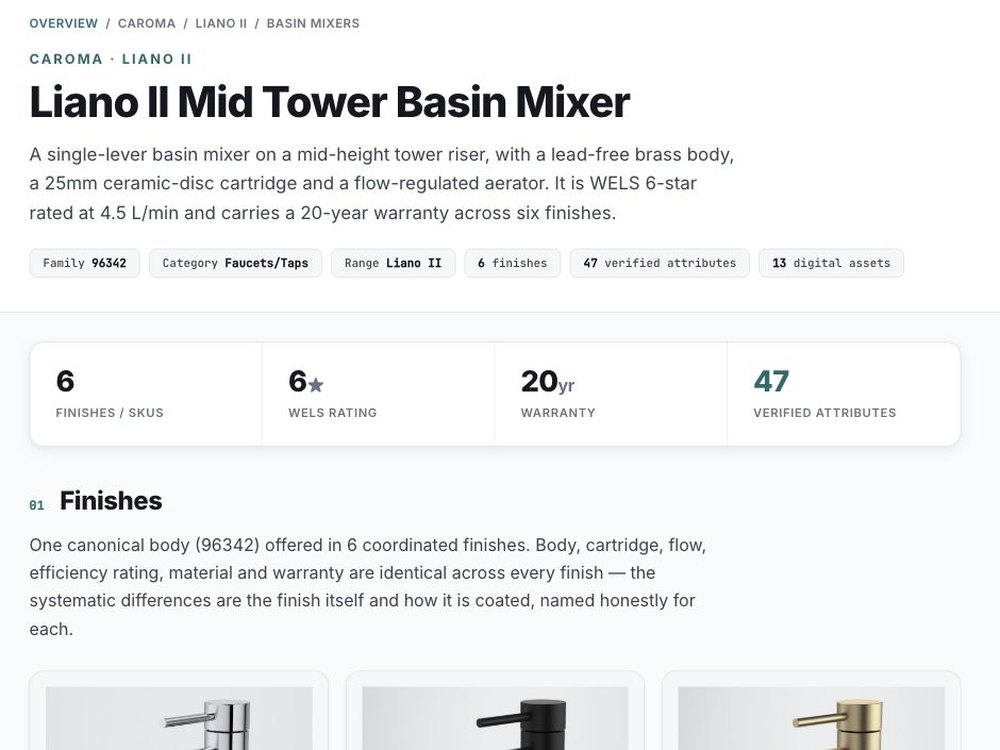
For the Caroma Liano II, the page, the counter card and the rep talk track lead with what the trade asks first: a cartridge a plumber can replace, and the warranty stated plainly.
A new sheet from the maker: the page, the card and the talk track change with it. Nothing goes live without your yes.
Send the makers’ PDFs and your product export as they are. SalesChef reads them and sends checked records back where your team works.
See every integration Excel and CSV
 SharePoint
 Box
 Dropbox
 Google Drive
The maker’s document of a product’s specs: materials, performance, dimensions, ratings and approvals.
No. A technical data sheet covers specs and performance. A safety data sheet covers hazards, handling and emergencies, in the 16-section format OSHA specifies.
Mostly, yes. Makers use datasheet, spec sheet and technical data sheet for the same document of specs.
A product data sheet is usually shorter and written for buyers: the key specs, a picture and the order codes. The technical data sheet carries the full detail.
The product’s name and codes, what it is made of, how it performs, its sizes and fit, its approvals and warranty, and the date of the version.
SalesChef reads every maker’s data sheet, checks each spec against the newest version and turns the specs into product pages, counter cards and rep talk tracks. Your team approves.
A wall of products already finished. Each one turns from what the supplier sent into a finished product, ready for online, in store, sales and campaigns.